


TALKS AND CONFERENCES
Since the beginning of Vertigo Graffiti we have studied and analyzed the phenomenon of art in the city and the culture and practice of graffiti, as a result we have developed conferences, talks and opinions
Interview published in the cultural magazine of the newspaper El Espectador, January 10, 2016.
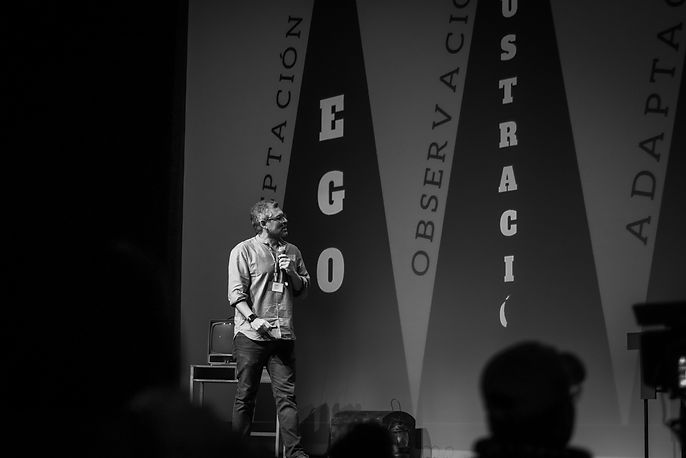
Graffiti Thinking, TEDx Talk, November 2025. Camilo Fidel López, director of Vertigo Graffiti
Juan David Zuloaga, art critic and cultural manager
What is the relationship between graffiti and art? Is there a dialogue, a counterpoint, or is it a specific genre within the visual arts?
Art, as a product of expression, shares the same origin as graffiti. The most significant difference is that graffiti doesn't require individuals or institutions to recognize it as such, or for artists to be officially designated as artists. In contrast, the art world, and its markets, have been built upon these kinds of schemes and structures of recognition and validation. Graffiti is always pure expression, without intermediaries, without validators; art, unfortunately, is not.
So, where did graffiti originate?
If one wanted to pinpoint the origin of graffiti, one could trace it back to prehistoric expressions on the cave walls of Spain and southern France (as many texts support). These narratives depicted the environment, hunting, bison, and reality; a process very similar to what happens in the streets of the world today with graffiti.

The Painted Walls Theory, TEDx Talk, November 2012
What are its aspects?
There are different ways to do graffiti. Almost everyone has, at some point in their lives, engaged in some form of writing on a wall or other surface. However, it could be argued that today there are two very distinct types of graffiti found in almost every city in the world: Writing and Street Art. The former, originating in Philadelphia in the late 1950s and popularized in the New York subway during the 1970s and 80s, is based on the repetition of a name, with characteristics akin to abstract expressionism, comics, and pop art. The latter, in a way a product of the last historical avant-gardes of the 20th century, is a descendant of Dada, Situationism, and other movements that brought it closer to everyday life and the city, and whose most significant reference point is the May 1968 protests.
When did graffiti begin to take shape in Colombia? And what is its most immediate legacy?
Again, if one wanted to investigate when walls began to be seen as an attractive form of communication in Colombia, one could look to what was happening in the territories now occupied by Usme or Bogotá ten thousand years ago, where indigenous pictographs were found on sizable stones. Another striking precedent lies in our narrative of Independence: when Francisco José de Caldas, with a piece of charcoal, drew a circle crossed by a line—for many, the Greek letter Theta, which begins the word "Thanatos," meaning death. Not surprising, considering he was being taken to be executed at that moment.
And in more recent times?
Later, in the 20th century, invoking student and social causes and inspired by the events of May 1968, political graffiti began to be used more frequently. In fact, the M-19 guerrilla group used graffiti as an active tool for communication and propaganda. Then, in the 1980s, with the arrival of Hip-Hop culture, the first North American graffiti artists began to appear in Colombia, first in Medellín and then in Bogotá. From there, both paths continued to grow. The peak occurred in the late 1990s.
What is the relationship of the graffiti artist with the city, which, in principle, could be considered a public space, a space for everyone, and what does the graffiti artist's initiative to transform it depend on?
This is one of the most controversial and debatable topics: for the graffiti artist, the city is their natural field of action. What has been said, especially by graffiti theorist Anna Waclawek, is that graffiti challenges the visual imposition inherent in the city and its components: the bridge, the red of the Transmilenio bus system, outdoor advertising; what graffiti seeks, then, is to balance the forces in a process that has never been democratic, such as the development of the city.
Considering the questions that graffiti raises for many regarding the idea of defacing the city, is there an aesthetic to graffiti?
Following the Greek perspective, aesthetics cannot exist without an underlying ethics; aesthetics is a product of ethics, and the two are inextricably linked. The ethics of graffiti is a reclaiming of public space; it is both the result and the response to the anonymity inherent in the urban sprawl. The "I like it" or "I don't like it" debate is one that no one can win, but neither can anyone lose. We live in a society that does not allow for equal participation in expression, and it is within this context that the moral vindication of graffiti arises.
Lead Yourself Podcast, CESA University, Colombia. 2025


You emphasize that graffiti does not abuse, but rather uses public space, employing it to make it more humane, more passable, less forgotten.
If I were to say that graffiti isn't abuse, I would likely be contradicting the traditional definition of the term. However, there is a necessary confrontation in public spaces; it's a competition in the visual construction of the city, a healthy one because it's simply painting—zero violence, zero injuries in practice. Violence comes with prohibition. Yes, there is abuse, but it's an abuse that's part of a conversation, that validates it.
What is the role of the public sector in regulatory terms? What does the law say?
Bogotá arguably has one of the most cutting-edge regulations on graffiti, featuring three major advances: first, the recognition of graffiti as a cultural practice; second, that sanctions do not include imprisonment; and third, the involvement of the private and public sectors in the development of graffiti. This regulation addresses the reality of the futility and arbitrariness of a blanket ban. It represents an exercise in understanding graffiti.
And what about with the new administration?
With the new administration, new regulations will surely come. Let's hope we don't revert to a prohibitionist approach like the one that existed before, which would be a grave mistake. The day we return to the physical violence involved in detaining graffiti artists, I'm sure we'll see cases of abuse and death of young people again. Police power must be limited as much as possible because it tends to be excessive, in any context.
What role does public funding play in the practice of graffiti?
The biggest risk is the editorialization of graffiti. In some cases, the public sector turns graffiti into a tool of its discourse. Hopefully, public funding will increase, but it shouldn't become an ideological tool. It seems the public sector prioritizes certain topics over others, and this hinders the free flow of ideas in the streets: if we only talk about peace, we risk structurally affecting the diverse conversation that serves as the raw material for expression.
So what is the public sector for?
The public sector must recognize that the needs and urgent requirements of graffiti include the professionalization and internationalization of the practice, as well as training and support programs for children and young people who want to participate. This can be achieved by creating environments capable of generating collective and individual artistic heritage, fostering businesses as valuable as tourism, and, moreover, allowing many young people to escape the risks of violence, drug use, and, most seriously, boredom .
It seems that the global graffiti movement arose more or less spontaneously, more or less chaotically. It appears that his efforts as a graffiti promoter in the Vértigo project sought to create some coherence for working as a group with its members. What is the purpose of Vértigo Graffiti?
The purpose of any industry connected to the cultural sphere is to make mistakes. That's always the first step. The most frequent error occurs when it's suggested that graffiti, theater, or the circus, to name a few examples, are objects of industry. This is a mistake. What are truly objects of industry are the codes within the cultural practice. That's what can actually be industrialized, in the case of graffiti: chaos, speed, surprise, imperfection. Graffiti, of course, cannot be domesticated, not even by industrializing those codes. What we've learned is that we must transform all that 'DNA' into products that represent an economic alternative for the graffiti artist and a valuable object for the consumer—a market. And this isn't new.
Which projects, in terms of artistic merit and social impact, do you remember most fondly?
The three I remember most vividly involved the public sector, the private sector, civil society, and artistic talent as part of a model we've called the Painted Walls Theory. These three projects are: Prisma Afro in Cartagena, El Beso de Los Invisibles in Bogotá, and Las Abuelas de Aguablanca in Cali.
Vértigo has just opened its gallery specializing in graffiti, what is the future and purpose of the gallery?
I mentioned that one of the elements of graffiti's 'DNA' is surprise. That's what we want to be: a pleasant surprise. We want to show all visitors that when graffiti moves into formal art spaces, it can do very well in terms of its quality and composition. We want visitors to arrive with a preconceived idea of graffiti and leave with a different one, forged from recognizing the artists' talent and, furthermore, to see what's happening on the street. What isn't always popular is part of training and awareness processes that took time and experience, processes that allow galleries and collections like this one to exist and open their doors to the public.
Graffiti Thinking, Ted X Talk, November 2025